Hosted September 2026
In this webinar, New Disabled South and New Disabled South Rising explore how community care can lay the foundation for collective and political power. Through the care webs model, Dom Kelly, Mel Moore, and Shun Tucker-Allen share what it looks like to strengthen networks of mutual support that help people meet immediate needs while building trust, leadership, civic participation, and the power to shape the systems that affect their lives.
The conversation moves between rural communities, disability justice, civic engagement, and organizing to examine what becomes possible when care and political participation are understood as connected. Rather than asking people to show up for a campaign while they struggle to survive, care webs create opportunities to build relationships, meet one another’s needs, share information, and develop a sense of collective power.
The result is a different approach to organizing: one rooted in staying, building alongside communities, and investing in relationships that can outlast any individual campaign or organization.
Please note that this conversation was in the context of funding 501(c)(3) work, and reference to C4 activity during was for informational purposes only.
Care Webs: Building Community Care and Collective Power
from Rx Foundation’s Power is a Social Determinant of Health series
Session description: Care is often treated as separate from organizing and political power. This conversation offers a different way of seeing the relationship.
New Disabled South and New Disabled South Rising have been building political and organizational infrastructure to help community-based care webs take root across the South. The approach starts with something deceptively simple: people need to have what they need to survive before they can be expected to consistently participate in civic and political life.
Dom Kelly, Mel Moore, and Shun Tucker-Allen share how that understanding shapes their work with disabled people and communities, particularly in places where traditional systems of care have excluded or harmed the people they are meant to serve.
Together, they explore how to identify and strengthen networks that already exist, how trusted community relationships can move information and resources, and how meeting immediate needs can create the conditions for people to recognize and exercise their collective power.
The conversation also introduces pod mapping, a practical tool for making networks of support visible, and offers examples of care webs becoming infrastructure for organizing—from neighborhood care canvassing in South Carolina to campaigns for better wages for caregivers and efforts to increase civic participation.
Please note that this conversation was in the context of funding 501(c)(3) work, and reference to C4 activity was for informational purposes only.
Session Highlights
Care is part of the infrastructure of political power
It is difficult to build political power when people are focused on surviving.
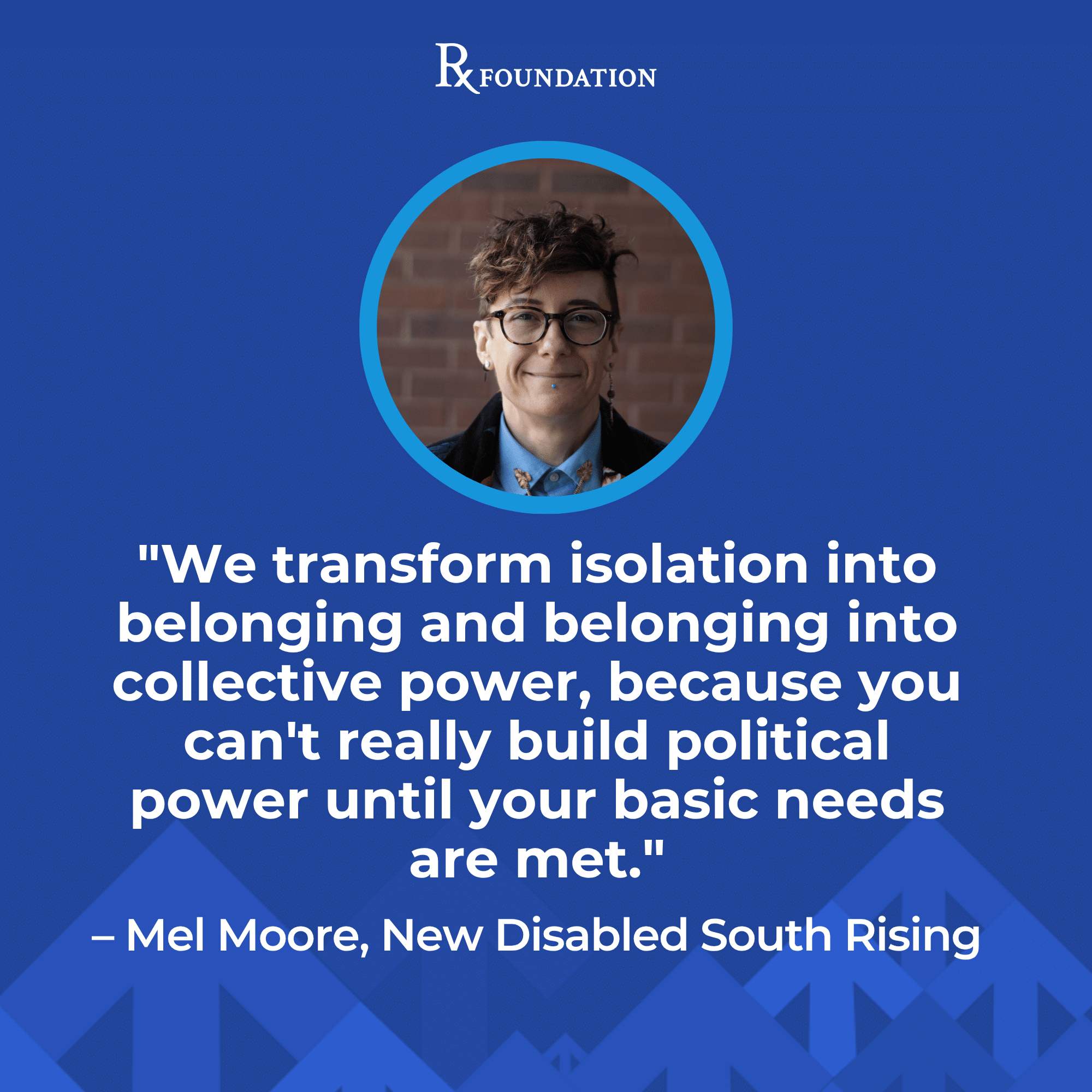
Mel Moore describes the connection plainly: “You can’t really build political power until your basic needs are met.” For disabled people in the South, that can mean navigating inaccessible systems of care, inadequate wages for care workers, transportation barriers, rural hospital closures, and other conditions that make daily life more difficult.
New Disabled South responds by pairing mutual aid with political education and strengthening the relationships that already exist in communities. The goal is to move from isolation to belonging—and from belonging to collective power.
Build alongside communities, not into them.
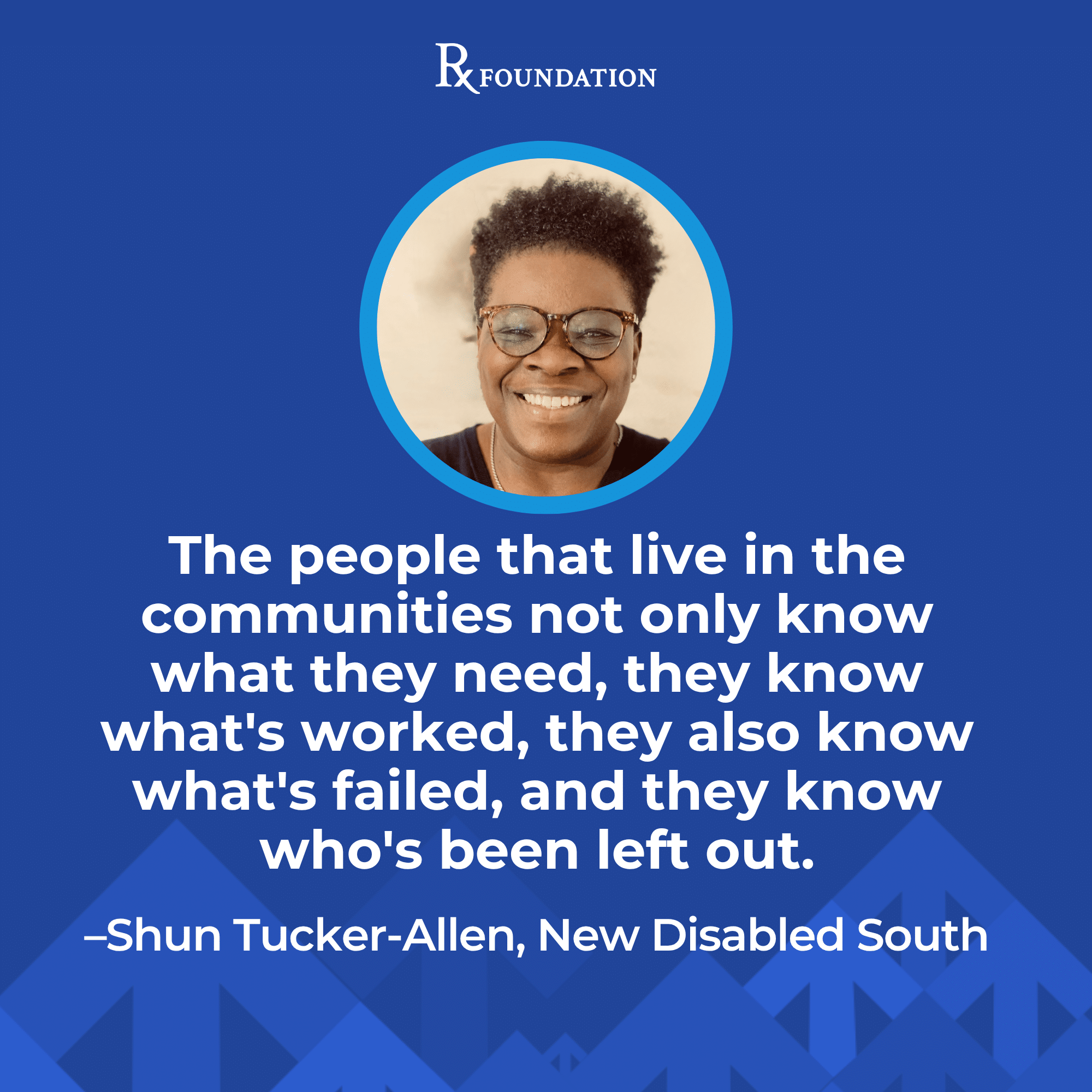
Shun Tucker-Allen draws an important distinction between building in a community and building alongside a community.
People who live in a community know what they need. They also know what has already been tried, what has failed, which systems of care are working, and who has been left out.
That changes the role of an outside organization. Instead of arriving with a predetermined solution, the work becomes one of listening, identifying existing relationships, bringing resources where they are useful, and helping communities build power around what they already know they need.
Communities already have care infrastructure
Care webs are not necessarily something to build from scratch.
Tucker-Allen points to the community doctors, church feeding programs, neighborhood relationships, faith leaders, elders, and other informal systems that have long helped communities survive. In rural communities especially, these relationships can be essential infrastructure.
The opportunity is to recognize that infrastructure and invest in it rather than overlooking it because it does not look like a traditional nonprofit program.
Staying is part of the work
Building trust takes time. One of the clearest themes throughout the conversation is the importance of staying connected to communities long enough to understand them.
Tucker-Allen described asking who is trusted, who is already serving people, who is connected to schools and food programs, and who has relationships with local government. She also looks through a disability lens: Who is not receiving information? Who cannot get to the clinic or food distribution? Who cannot get to the polling place? Who is being discussed without being included?
Those questions help reveal people who might otherwise remain invisible to traditional organizing and service systems.
Care can become a pathway to political action.
One of the clearest examples came from South Carolina.
Beginning in 2020, community anchor Tiffany James organized care canvassing in neighborhoods experiencing disinvestment, poverty, and isolation among older residents. She built on relationships with neighborhood associations and community leaders, creating a network that continued checking in on one another.
New Disabled South supported that existing work with resources, including a small grant for a community joy event. From there, residents began identifying additional needs—including better pay and support for caregivers.
Community members were trained to advocate for two bills seeking to raise caregiver wages. They trained others in their communities, partnered with the National Domestic Workers Alliance around the care crisis, and organized a lobby day at the South Carolina State House.
The numbers tell the story:
– The two bills were introduced in April 2025.
– For nearly a year, they had only their original sponsors.
– On March 3, 2026, community members participated in a lobby day.
– 123 sponsors were added that day, followed by three more the next day.
– The bills subsequently received hearings in both the House and Senate.
The organizing did not begin with the lobby day. It began with people caring for one another, building relationships, and creating the conditions for people to see themselves as capable of moving something together.
Care webs can help close information gaps
Information is itself a resource—and in rural communities, access to accurate civic information can be limited.
Tucker-Allen described rural communities as information deserts, particularly when it comes to civic information and the spread of misinformation and disinformation. But providing accurate information is not enough. People need to receive that information through relationships they trust.
That is where care webs become especially important. Churches, educators, caregivers, community leaders, and other trusted relationships can become pathways through which information, resources, and opportunities for civic participation move.
Interdependence—not independence—is the source of power
Care webs make visible something that people already know through lived experience: no one survives entirely on their own.
Pod mapping provides one way to make those relationships intentional. A pod can include people who provide immediate support, people who could join the network as trust develops, and larger communities or organizations that can offer additional resources.
The network is not static. People’s needs change. People get sick, experience conflict, need time away, or can no longer provide the same support. Building a sustainable care web means planning for those realities and continuing to develop relationships.
As Moore put it, “The power is not independence, the power is interdependence.”
Build for the generations that come next
The work described throughout this conversation is not only about responding to the immediate moment.
New Disabled South is thinking about what it means to create conditions for disabled people across the South to shape what comes next. That means investing in relationships and infrastructure that can support communities over time and creating space for the people who will carry the work forward.
As Kelly reflected in closing, organizing has a long generational arc. What communities build now can shape what becomes possible for people generations from now.
Noteable Quotes
Resources
Pod Mapping
New Disabled South shared an interactive pod-mapping tool that helps people identify the relationships and communities they can turn to for support, as well as relationships that could become part of their support network over time.
New Disabled South pod-mapping
Disability Justice Principles
Mel Moore referenced the Disability Justice Principles and the work of Mia Mingus and Sins Invalid in describing the framework behind pod mapping and care webs.
Disability Justice Principles
New Disabled South
New Disabled South and New Disabled South Rising work across 14 states in the U.S. South to advance disability justice and rights through cross-movement organizing, disability advocacy, accessible education, research, and policy and narrative change.
New Disabled South website
Speakers
Dom Kelly
President and CEO, New Disabled South and New Disabled South Rising
Dom Kelly is President and CEO of New Disabled South and New Disabled South Rising, regional disability justice and rights organizations serving 14 states across the U.S. South. The organizations work toward policy and narrative change through cross-movement organizing, disability advocacy, accessible education, and original research.
Mel Moore
Director, New Disabled South Rising
Mel Moore is Director of New Disabled South Rising, where they work to build the political power of disabled people. Their work includes strengthening community connections and supporting the development of care webs and organizing infrastructure rooted in disabled people’s experiences and needs.
Shun Tucker-Allen
Director of Faith and Community Partnerships, New Disabled South
Shun Tucker-Allen is Director of Faith and Community Partnerships at New Disabled South. Her work draws on longstanding relationships with rural and Southern communities and trusted networks including faith leaders, community advocates, educators, and caregivers.