
In 2022, the Rx Foundation spoke with United Vision for Idaho (UVI), one of our first grant partners, about their bold work defusing extremism in rural America. Since then, their outreach has expanded across 12 states and hundreds of thousands of conversations. We checked back in with Adrienne Evans, Executive Director, and Bri Xandrick, Associate Director, to hear how their work has evolved and what they’re learning in this critical moment for democracy.
United Vision for Idaho is showing what’s possible when democracy is rebuilt through relationships, not algorithms. In places too often written off, their approach is transforming hardened divisions into dialogue—and pointing the way toward a democratic renaissance.
Radical Work in Forgotten Corners
In the forgotten corners of America—where hospitals have closed, hope has withered, and extremism has moved in—the future of democracy is being defined. United Vision for Idaho (UVI) has spent years doing something radical: strategic rural organizing at depth and scale.
What began as healthcare organizing soon revealed something deeper: generational pain hardened into disillusionment about whether our democratic systems could ever deliver meaningful and lasting change.
This was a wake-up call. As the Rx Foundation came to see firsthand through its network of grantee partners, people’s access to agency, representation, and voice is inseparable from health itself. Democracy is not just adjacent to well-being—it is one of the conditions that makes well-being possible.
Adrienne Evans, Executive Director of UVI, explains:
“When someone comes along and says we need to break the systems we’ve been operating under that haven’t been serving them for generations, it probably sounds pretty good. The heartbreak of it is that so many have seen themselves in an oppositional relationship with their forms of governance instead of having the power to change them.”
But instead of treating that moment as a potential democratic revival, many still see rural and conservative places as politically lost. UVI understood this as an essential intervention—with great promise.
Reframing the Work
We must first cultivate the social and cultural conditions—through authentic relationship-building—that create the foundation for durable, structural policy gains. Without a relational base, policy victories remain fragile, out of reach, vulnerable to reversal, and disconnected from the very people they aim to benefit.
If authoritarianism thrives on binaries—good vs. evil, us vs. them—then UVI’s work is a powerful counterforce.
A Democratic Frontier, Not a Dead End
To fully appreciate what makes this work so vital, it’s important to understand what sets United Vision for Idaho and the United Vision Project apart. This is not a traditional outreach program. It is strategic organizing that yields insight, creates openings for intervention at the national scale, and delivers impact.
UVI and UVP remind us: rural America isn’t a political dead end—it’s a democratic frontier. And the future of our country may well depend on what we choose to invest in right now.
Beyond metrics, the work’s impact is best illustrated through the voices of participants. As one texter reflected,
“ARC is more than outreach—it is a training ground for empathy, resilience, and conflict de-escalation. Volunteers take these skills back into their families, workplaces, and communities, multiplying the impact.”
Another described how the practice reshaped their approach to disagreement:
“The biggest thing for me is that being right is not as important as being connected. I know I’m not going to get somewhere if I just want to be right. I need to listen, I need to try to understand, and I need to try to connect. This has been helpful from so many different perspectives beyond politics, too… it’s changed how I show up in everyday life.”
Texters also spoke to how the work softened their stance toward others:
“It’s helped me to be more accepting of others’ opinions and to try to understand where their thoughts are rooted. I’m not as angry as I once was, where the anger was directed at the person rather than the actual concept. Now, I can separate the two.”
Respondents, too, shared how transformative it was simply to be heard. One said:
“It was actually really nice being able to speak my mind… I think if more people have the opportunity to speak without being shouted down, we might have better and more educated conversations. Thank you for your time and listening.”
Another offered:
“Let me thank you for being so open and listening without judgment! I appreciate that more than I can say.”
Others noted that these conversations felt therapeutic and opened the door to genuine dialogue where previously there was only hostility.
How the United Vision Project Works
Through a relational texting program, volunteers and trained conversationalists—representing progressive and liberal political identities—are paired with individuals who are experiencing an increase in extremist activity.
Using the Southern Poverty Law Center’s hate mapping, on-the-ground partnerships to identify high-risk areas by county and zip code, and predictive scoring of ethnic nationalist ideology, outreach begins with just one scripted question:
“Our country may be more divided than it’s ever been. What do you think is causing this?”
From there, conversations unfold in peer-to-peer dialogue, supported by UVI’s 64-page searchable conversation guide spanning over 200 issue areas. This is not a rigid script—it’s a tool for consistent practice, built to help organizers internalize core concepts, build conversational agility, and stay grounded in curiosity and care.
Insights at Unprecedented Scale
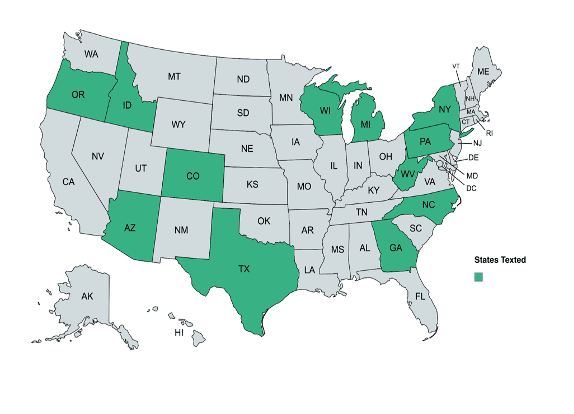
Highlights from the Dataset Include
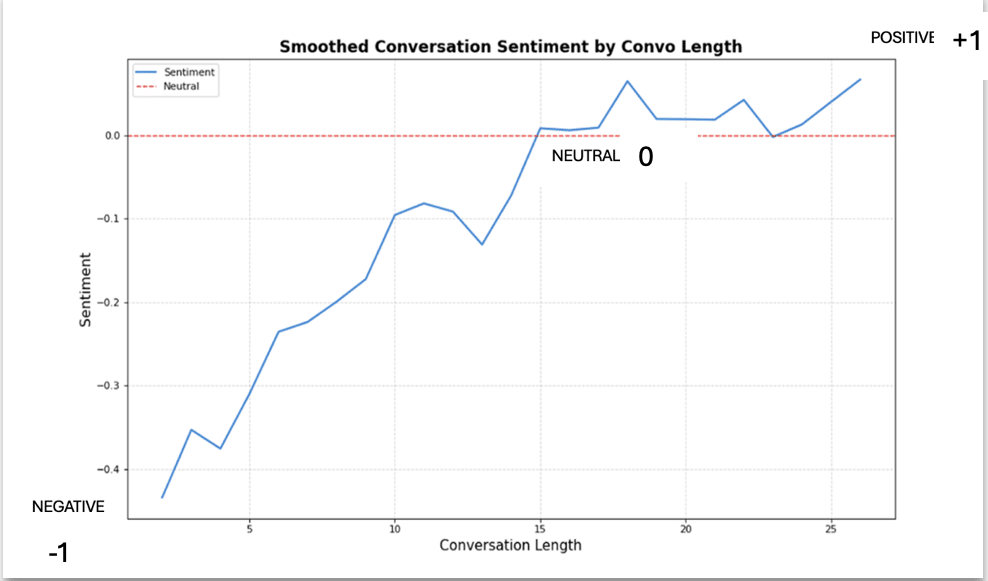
- In a sample of 800 conversations, participants who began with hostile sentiment (–0.4 on a –.1 to + 1 scale) shifted to neutral in 10–15 exchanges, and to positive by 16–25, with no reversals. “No reversals” means that once sentiment shifted to neutral or positive, no participant regressed to a negative sentiment during the course of the exchange.
- Conversation length is measured in the number of exchanges, which typically stretch over multiple days and, in some cases, weeks. As one respondent shared:
“Thank you for listening from a neutral position. Most of the people I know… would not likely be interested in hearing my list, be willing to discuss it, or would quite likely judge me harshly from some of the things I’ve stated.” - Of 35,844 analyzed texts of extended dialogue, the most cited grievances were not economic, but centered on cultural and social threats: misinformation, government overreach, and loss of identity.
- 48% of respondents named Democrats, liberals, or the federal government as the primary driver of division—revealing a massive trust deficit.
Conclusion: A Civic Renaissance Is Within Reach
The lessons of UVI and UVP show us what is possible: even in the most polarized places, connection is still possible. Democracy is still alive. Hope can be rekindled.
What’s at stake is nothing less than a civic renaissance—grounded not in algorithmic targeting or transactional mobilization, but in authentic connection. Not in soundbites, but in sustained practice. Not simply in opposition to authoritarianism, but in the construction of something more compelling and life-affirming than it.
UVI’s approach offers more than hope—it offers a tested method for rebuilding the foundations of democracy. It is a movement grounded in relational power, and a mirror showing what becomes possible when communities and funders come together with trust and vision. In this shared work, we see the possibility of a healthier, more just, and more democratic future.
Read our original 2022 conversation with United Vision for Idaho here.

Connect With Us on Social Media
Follow-us on social media for the most up-to-date news, resources, and events from the Rx Foundation and its partners.